
Women Who Changed the Terms
Four very different ways of refusing the expected path
I've been thinking about what actually makes me interested in another woman's story.
It isn't simply that she succeeded.
Success by itself doesn't tell us very much.
I'm more interested in what she had to negotiate along the way.
What was expected of her?
What wasn't?
What did she accept?
What did she question?
And what happened when she entered a place where someone like her had rarely—or never—been before?
The four women here couldn't be more different.
One is an economist from Nigeria.
One was an English teacher who became the face of a political opposition movement in Belarus.
One built a career in technology and media.
One became a world champion by entering a boxing ring in India at a time when women's boxing was barely taken seriously.
I didn't choose them because they fit neatly together.
They don't.
I chose them because each, in her own way, had to deal with someone else's idea of where she belonged.
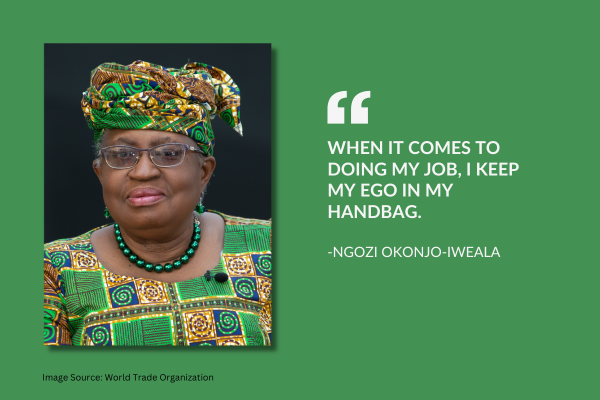
Ngozi Okonjo-Iweala — Being First Isn't the Job
In 2021, Ngozi Okonjo-Iweala became Director-General of the World Trade Organization.
She was the first woman to hold the position.
She was also the first African.
Those are important facts.
But they're also the kind of facts that can swallow the person underneath them.
Before the WTO, Okonjo-Iweala had already spent decades working as an economist and development specialist. She spent 25 years at the World Bank and twice served as Nigeria's Finance Minister.
Her work there included tackling something considerably less glamorous than making history: public finances, debt, institutions, corruption and the difficult business of trying to reform systems from inside them.
And I think that's the part of “first woman” stories we sometimes miss.
We celebrate the photograph when she gets the job.
Then she has to do the job.
In Okonjo-Iweala's case, that has meant trying to find agreement among countries that frequently disagree about trade, economics and almost everything else.
In November 2024, WTO members appointed her to a second four-year term, which began in September 2025 and runs through August 2029.
So perhaps the interesting question isn't simply:
What does it mean to be the first woman through the door?
It's:
What do you do once you're inside?
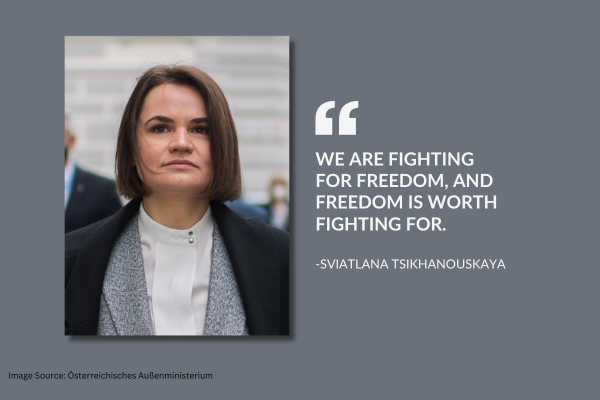
Sviatlana Tsikhanouskaya — The Life She Hadn't Planned
Sviatlana Tsikhanouskaya wasn't building a political career.
She was an English teacher and translator.
Then, in 2020, her husband, Siarhei Tsikhanouski, planned to challenge Belarusian president Alexander Lukashenko and was arrested.
Tsikhanouskaya entered the presidential race in his place.
Think about the distance between those two lives for a moment.
Teacher.
Mother.
Translator.
Presidential candidate.
Leader of an opposition movement.
Exile.
Her story is often described as the story of an “accidental politician.”
Maybe.
But I've become interested in what happens after the accident.
Because circumstances can put someone in an unexpected position.
They don't make her stay there.
Tsikhanouskaya did.
She continued organizing and representing Belarus's democratic opposition from exile and remains a central leader of the country's democratic forces.
There's something about that transition I find fascinating.
Sometimes we spend years preparing for the life we want.
And sometimes life puts something in front of us that we never trained for.
Then the question becomes much simpler and much harder:
What am I going to do now?
Anjali Sud — Changing Direction From Inside the Business
Anjali Sud became CEO of Vimeo in 2017 at 34.
But the part of her story I find more interesting isn't her age.
It's what happened to the company.
Vimeo was competing in an online-video world dominated by much larger platforms. Under Sud, its focus shifted increasingly toward providing video tools and services for businesses and creators rather than simply trying to become another mass entertainment destination.
That's an interesting kind of leadership to me.
Sometimes progress isn't doing the existing thing better.
It's realizing that perhaps you're doing the wrong thing.
Sud left Vimeo in 2023 and became CEO of Tubi, where she still leads the streaming company today.
Different company. Different problem.
But again there's that willingness to move rather than remain attached to the identity that made you successful n the first place.
I think we underestimate how difficult that can be.
Knowing when to persist matters.
So does knowing when to change direction.
Mary Kom — Making Room in the Ring
Mary Kom grew up in rural Manipur in northeastern India.
Her family were farmers, and boxing was hardly an obvious future for a girl.
She pursued it anyway.
What followed was an extraordinary career: multiple world titles, an Olympic bronze medal at London 2012, motherhood, returns to competition and years spent becoming one of the most recognizable figures in Indian sport.
But again, the medals aren't the only reason I wanted her here.
I'm interested in what happens when a woman enters a space that wasn't designed with her in mind.
At first, she has to prove that she belongs there.
If enough women follow, eventually the question itself starts to look ridiculous.
That's the real change.
Not:
Look, a woman can box.
But:
Why did anyone ever think she couldn't?
Four Women, No Single Lesson
I don't think these four stories give us one tidy lesson.
Nor should they.
Ngozi Okonjo-Iweala spent decades preparing for the rooms she eventually entered.
Sviatlana Tsikhanouskaya entered one she never expected to be in.
Anjali Sud changed direction inside industries that change constantly.
Mary Kom walked into a boxing gym and pursued a sport that people around her did not necessarily imagine for girls.
Different women.
Different circumstances.
Different choices.
What connects them, for me, isn't simply that they “broke barriers.”
It's that at some point, each encountered an assumption about what was possible, expected or already decided.
And didn't automatically accept it.
A Question to Carry With You
What is one assumption about your own life that you've never really questioned?
Not necessarily one you need to reject.
Just one worth looking at again.


She Asked Why
Five women, five questions, and the curiosity behind science

One of the things I love about science is that it often begins with something very small.
A question.
Why does this happen?
What is this?
What if we tried it differently?
What are we missing?
I wasn't a science student. Languages and literature were my world.
But curiosity doesn't belong to one subject.
I've spent much of my life learning languages because I wanted to understand what happens when people use different words to describe the same world. Scientists do something very different, of course, but I recognize the impulse.
You notice something you don't understand, and you want to know more.
The five women I've chosen here followed that curiosity in completely different directions.
One helped identify the virus that causes AIDS.
One studies something as ordinary—and scientifically peculiar—as water.
One has carried experiments into space.
One helped send a spacecraft to Mars.
And one found an important malaria treatment by looking again at knowledge that was centuries old.
Their stories remind me that science doesn't always move forward in a straight line.
Sometimes progress begins by looking somewhere other people haven't.
Françoise Barré-Sinoussi — What Is Causing This?
In the early 1980s, doctors were confronting a frightening new disease that nobody yet understood.
People were becoming seriously ill. The cause was unknown.
At the Institut Pasteur in Paris, virologist Françoise Barré-Sinoussi was part of the team investigating whether a retrovirus might be responsible.
In 1983, the team reported the isolation of a new human retrovirus that would later be known as HIV.
That discovery fundamentally changed the scientific understanding of AIDS and opened the way to diagnostic tests, further research and eventually effective treatments. In 2008, Barré-Sinoussi and Luc Montagnier received the Nobel Prize in Physiology or Medicine for the discovery of HIV.
But I think it's easy, looking backwards, to forget what discovery actually means.
They didn't know the answer yet.
They had a hypothesis.
They tested it.
Something unexpected happened.
They looked more closely.
That's science before it becomes something we read as a fact in a book.
Márcia Barbosa — Why Is Water So Strange?
Water seems like a peculiar thing to devote a career to.
Until you discover how peculiar water actually is.
Brazilian physicist Márcia Barbosa has spent years studying its unusual physical properties and the way water behaves under different conditions.
That research matters because water isn't simply something we drink.
Understanding its behaviour has implications across physics, biology, materials and other areas of science.
But there's another part of Barbosa's career I wanted to include.
Alongside her research, she has been an outspoken advocate for women in science and for greater equality within scientific institutions. She received the L'Oréal-UNESCO Award for Women in Science in 2013 and has held leadership roles in Brazilian science.
I like the combination.
Study the problem in front of you.
But also notice who is being given the opportunity to study it.
Science is shaped by questions.
It's also shaped by who gets to ask them.
Kellie Gerardi — What Can We Learn Up There?
In November 2023, Gerardi flew aboard Virgin Galactic's Galactic 05 research mission as a payload specialist, conducting experiments during the flight.
Her work focuses on bioastronautics: essentially, what happens to human beings and biological systems in space and altered-gravity environments.
And that's the part that interests me.
Spaceflight can easily become a story about rockets, records and spectacular photographs of Earth.
But eventually, if humans are going to spend more time away from Earth, we need answers to considerably less glamorous questions.
What happens to the human body?
How do we conduct medical research there?
How do we train people to work safely in those environments?
Gerardi has been involved in research addressing questions like these, including work related to women's health in altered gravity.
Her career also reflects something relatively new in space exploration: scientific research is no longer limited entirely to traditional government astronaut programmes.
Who gets to go to space—and what they do once they're there—is changing.
I'd rather leave her story there than write about her next planned flight.
Because plans change.
The work she's already done won't.
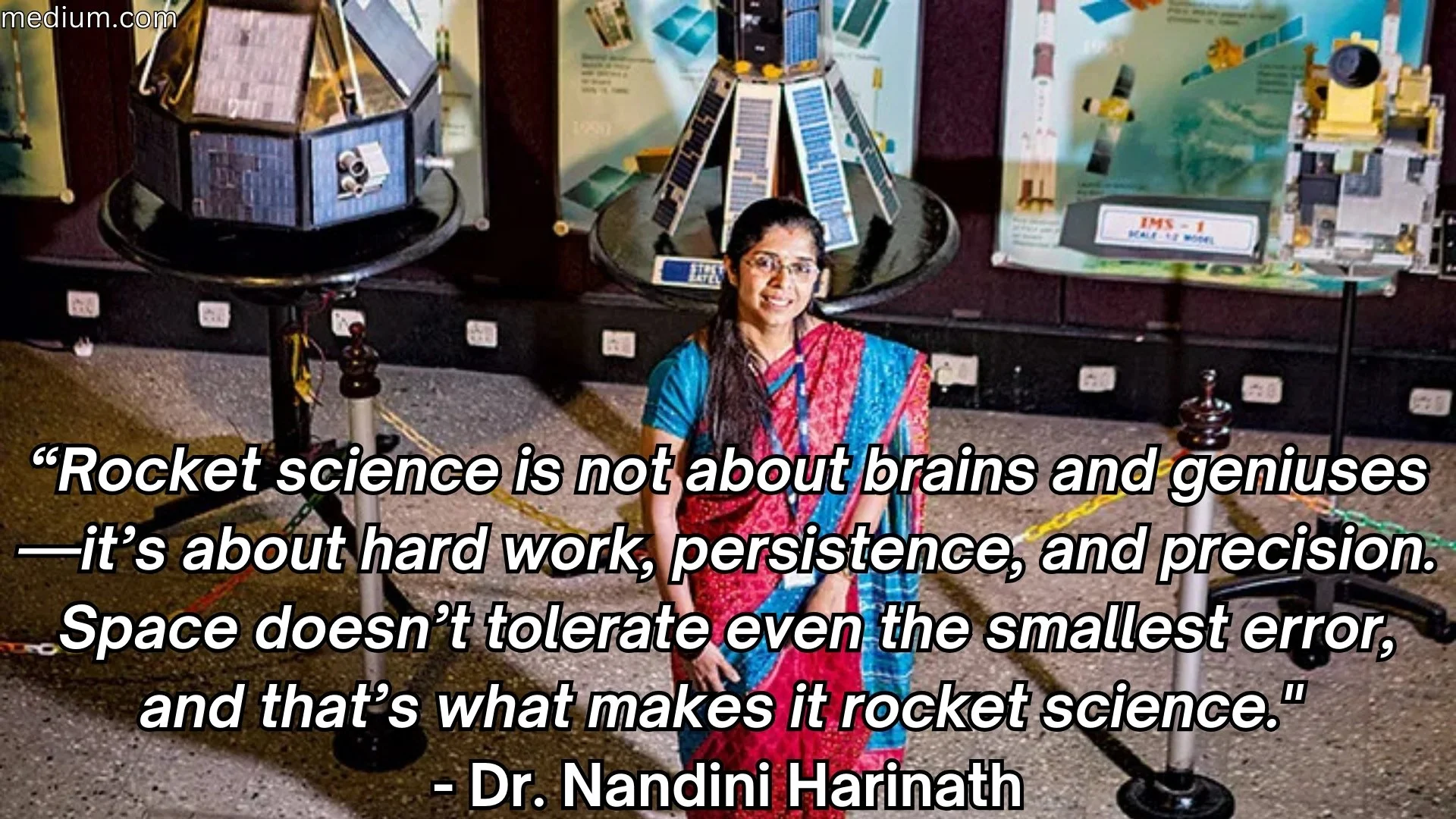
Nandini Harinath — How Do You Get to Mars?
As a child in India, Nandini Harinath encountered science fiction through Star Trek.
Years later, she became a rocket scientist with the Indian Space Research Organisation.
And eventually Mars stopped being fiction.
Harinath was part of the team behind India's Mars Orbiter Mission, known as Mangalyaan, which launched in 2013 and entered orbit around Mars in 2014.
I love the enormous distance contained in that sentence.
A child watches an imagined version of space exploration.
She studies mathematics and science.
She becomes an engineer.
And one day she's working on an actual mission to another planet.
But again, I'd resist turning that into “dream big and anything is possible.”
That's too easy.
Space missions aren't built from dreams alone.
They're built from calculations.
Testing.
Budgets.
Engineering.
Teams of people solving one problem and then discovering another one behind it.
Perhaps that's the more useful version of dreaming.
Wonder gets you interested.
Then comes the work.
Tu Youyou — What If the Old Text Knows Something We Don't?
Tu Youyou's story may be my favourite of the five because the direction of discovery is so unexpected.
During efforts to find new treatments for malaria in China, Tu and her team investigated traditional Chinese medical texts for possible leads.
One plant—Artemisia annua, or sweet wormwood—looked promising.
But early results were inconsistent.
Instead of abandoning it, Tu went back to the historical literature.
A centuries-old description of preparing the plant at a lower temperature helped inspire a different extraction method.
That change mattered.
It eventually led to the isolation of artemisinin, which became the basis of highly effective antimalarial treatments and has helped save millions of lives. In 2015, Tu received the Nobel Prize in Physiology or Medicine for her discoveries concerning artemisinin.
I find something beautiful in the method—not in a sentimental way, but intellectually.
Scientific progress came from looking backwards as well as forwards.
Old knowledge wasn't accepted simply because it was old.
Nor was it dismissed because it wasn't modern.
It provided a clue.
Then science tested the clue.
That distinction matters.
Five Women, Five Different Kinds of Curiosity
Françoise Barré-Sinoussi was trying to identify the cause of a terrifying new disease.
Márcia Barbosa looked closely at something so familiar we barely notice how strange it is.
Kellie Gerardi took experiments somewhere humans have only recently been able to work.
Nandini Harinath helped answer an engineering question that once belonged to science fiction.
Tu Youyou found a useful scientific lead in knowledge written down centuries earlier.
None of these stories tells us that curiosity inevitably leads to discovery.
Most questions don't end in Nobel Prizes or missions to Mars.
Sometimes an experiment fails.
Sometimes the hypothesis is wrong.
Sometimes years of work produce another question rather than an answer.
But perhaps that's part of what makes science interesting.
Not knowing isn't the failure of science.
It's where science begins.
A Question to Carry With You
What is something you don't understand—but would genuinely love to know more about?
Not because it would make you more successful or productive.
Just because you're curious.




Learning to Trust Yourself
When your own voice becomes one you listen to
For a long time, I thought trusting yourself meant being confident.
Knowing what you wanted. Making a decision and not looking back. Being certain.
I don't think that anymore.
Sometimes self-trust looks much less impressive.
It's noticing that something doesn't feel right and not immediately talking yourself out of it.
It's saying, I need more information.
It's changing your mind.
It's asking another question when the first answer doesn't satisfy you.
It's saying no without producing a five-minute explanation for why.
And sometimes it's admitting, I don't know yet.
I've spent a lot of my life looking outward for confirmation. Am I doing the right thing? Am I being reasonable? Am I asking too much? Should I let this go?
I'm getting better at asking a different question:
What do I think?
It sounds ridiculously simple.
It isn't.
Your Body Is Part of the Conversation
Self-trust becomes particularly important when we're talking about our bodies and our health.
Most of us have had moments when something felt different.
A pain that wouldn't go away.
A change we couldn't quite explain.
Exhaustion that didn't feel normal.
A symptom that seemed insignificant to someone else but didn't feel insignificant to us.
Listening to yourself doesn't mean assuming you know more than a doctor. And it certainly doesn't mean diagnosing yourself.
It means recognising that you bring information to the conversation too.
You live in your body.
You know what is usual for you.
You know when something has changed.
A good medical relationship needs both things: professional expertise and a patient who feels able to speak honestly, ask questions and understand the decisions being made.
That may mean saying:
Can you explain why you think that?
What else could be causing this?
What should I watch for?
What happens if this doesn't improve?
I'd like some time to think about that.
Or simply:
I'm still concerned.
None of those sentences is confrontational.
They're questions.
And you are allowed to ask them.
Self-Trust Isn't the Same as Always Being Right
This distinction matters to me.
Trusting yourself doesn't mean believing every thought you have.
Sometimes we're wrong.
Sometimes fear speaks very convincingly.
Sometimes another person sees something we can't.
Sometimes the doctor really does know better.
Self-trust isn't certainty.
It's knowing that your own experience deserves a place at the table.
You can listen to someone else's expertise without surrendering your judgment.
You can take advice without handing over every decision.
You can reconsider without betraying yourself.
And you can say, I need another opinion.
I think that's a much healthier definition of self-trust than simply telling ourselves to “listen to our gut.”
Sometimes our gut needs information too.

Tlaleng Mofokeng — Taking Women Seriously
Dr. Tlaleng Mofokeng is a South African doctor and advocate whose work has focused on sexual and reproductive health, bodily autonomy, and access to healthcare.
What interests me about her work is that she takes the idea of self-trust one step further.
It's one thing to tell a woman to speak up about her body.
It's another to make sure someone is actually listening.
For years, Mofokeng has spoken about the barriers that can stand between people and good healthcare—poverty, discrimination, stigma, lack of information, and systems that don't always treat everyone equally.
She served as the United Nations Special Rapporteur on the right to health from 2020 to 2026, becoming the first woman from Africa to hold that role. Her work brought particular attention to sexual and reproductive health and to the experiences of people whose voices are too easily ignored.
She is also the author of Dr T: A Guide to Sexual Health and Pleasure, a book that talks openly about bodies, sex, health, and choice—subjects women have often been taught to discuss quietly, if at all.
What I take from her work is something very simple:
Having a voice matters. But so does being taken seriously when you use it.
And that applies far beyond a doctor's office.
What Self-Trust Can Sound Like
Maybe self-trust doesn't need to sound powerful.
Maybe it sounds like this:
I need more time.
I don't understand. Can you explain it again?
That doesn't work for me.
I've changed my mind.
I'm still worried.
I need help.
No.
Yes.
I don't know yet.
I'd like another opinion.
There is something I find reassuring about that list.
None of those sentences says, I have everything figured out.
Because that's not what self-trust is.
It's being willing to listen to yourself while you're still figuring things out.
A Question to Carry With You
Where in your life do you find it hardest to trust your own voice?
And maybe a second question:
What would change if you took that voice a little more seriously?
You don't have to do anything with the answer.
Just notice what comes up.

When a Tradition Causes Harm
Women working to end female genital mutilation
There are subjects that are difficult to write about without either softening them or turning them into something sensational.
Female genital mutilation is one of them.
FGM refers to procedures that alter or injure female genitalia for non-medical reasons. It has no health benefits and can cause serious physical and psychological harm. It is internationally recognised as a violation of the human rights of girls and women.
It also isn't something that can be understood simply by saying, Why don't people stop?
Practices that have existed across generations can be held in place by family expectations, social pressure, ideas about marriage and sexuality, gender inequality, and fear of what may happen to a girl who doesn't conform.
That doesn't make FGM acceptable.
But it does help explain why ending it requires more than condemnation.
It requires laws and healthcare. Education. Community involvement. Support for survivors. And, importantly, people within affected communities who are willing to question something they may themselves have grown up believing was normal.
Progress has been made. Girls today are less likely to undergo FGM than they were several decades ago, although population growth means millions remain at risk and progress is very uneven.
And much of that progress has come from people doing the slow work of changing minds as well as laws.

Nafissatou Diop — Changing a Practice From Within
Dr. Nafissatou Diop has spent much of her career working on one of the hardest parts of ending FGM:
How do you change a deeply rooted practice without shutting down the very people whose participation you need?
Diop coordinated the UNFPA-UNICEF Joint Programme on FGM and worked on approaches that brought together governments, community leaders, health professionals, families and local organisations.
What interests me about this approach is that it recognises something we sometimes forget when talking about social change.
Telling people they're wrong isn't necessarily the same thing as helping them change.
When an idea is tied to family, belonging and tradition, change often requires conversation from within the community itself.
That work is slower than a slogan.
But sometimes slow is what lasts.
Ghada Hatem — Caring for the Women Who Are Already Living With It
Ending FGM is one part of the work.
There is another question that matters just as much:
What about the women who have already experienced it?
Dr. Ghada Hatem is a French gynecologist and the founder of La Maison des Femmes in Saint-Denis, near Paris.
The organisation brings different kinds of care together for women affected by violence, including women who have undergone FGM. Its teams include doctors, midwives, psychologists, psychiatrists, social workers, sexologists and legal professionals. It also provides a pathway of care for women seeking reconstruction after genital mutilation.
I think this belongs in the conversation because when we talk about ending a harmful practice, our attention naturally goes to prevention.
But survivors need more than our outrage about what happened to them.
They need care.
They need choices.
They need good medical information.
And they deserve to be treated as whole people—not simply as victims of something that was done to them.
Learn about La Maison des Femmes
Jaha Dukureh — Speaking From Experience
Jaha Dukureh's activism began with something she knew personally.
Born in The Gambia, she underwent FGM as a child and later became one of the most recognised advocates campaigning against the practice.
What matters to me about voices like hers is that they complicate the idea of outsiders arriving to “save” women.
Some of the strongest movements for change come from women within the communities affected.
Women who understand the traditions.
Who know the families.
Who understand why people hold on to certain beliefs.
And who can still say:
This needs to change.
That combination—belonging to a community while challenging something within it—isn't always easy.
But women like Dukureh show that loving where you come from doesn't require defending everything that happens there.
Sometimes love asks us to question it.
What Change Actually Takes
There isn't one woman who will end FGM.
There isn't one organisation, one law or one awareness campaign that will do it either.
The work happens at many levels at once: girls being protected, survivors receiving care, families having difficult conversations, health professionals being trained, communities changing expectations, activists speaking publicly and governments enforcing laws.
Recent UNFPA-UNICEF programmes involve thousands of grassroots organisations and large numbers of girls, women, boys and men—because lasting change cannot rest on girls alone.
And perhaps that's the part worth carrying beyond this particular issue.
We often celebrate the person brave enough to speak.
We should.
But change also depends on what happens after someone speaks.
Who listens?
Who believes her?
Who stands beside her?
And who is willing to change?
A Question to Carry With You
What is something your family, culture or community once treated as “just the way things are” that you now see differently?
And what helped that change happen?