

Women in STEM
What happens when someone asks a question nobody thought to ask?
Science and technology move forward because someone looks at what already exists and wonders whether it could work differently. A material. A machine. A building. A problem we have learned to live with.
The women featured here work across different areas of science, technology, engineering and mathematics. What connects them isn't simply what they have discovered or built.
It is their willingness to stay curious.
To look again.
To ask why this way?
And then, perhaps more importantly:
What else might be possible?
NERI OXMAN
What If We Grew Things Instead of Making Them?

Source: elle.comMost of the things we make are assembled.
A chair has legs attached to a seat. A building has walls, windows and beams. Different materials are manufactured separately and then put together.
Nature doesn't usually work that way.
A tree doesn't assemble its trunk and then attach its bark. A silkworm doesn't manufacture pieces of a cocoon and glue them together.
They grow.
That difference has occupied Neri Oxman for much of her career.
Born in Israel to architects, Oxman eventually found her way to a place somewhere between architecture, biology, engineering, materials science and computation. She calls her approach Material Ecology.
At its heart is a deceptively simple question: what could we make if, instead of forcing materials into the forms we want, we learned something from the way nature creates?
The answers have sometimes been extraordinary.
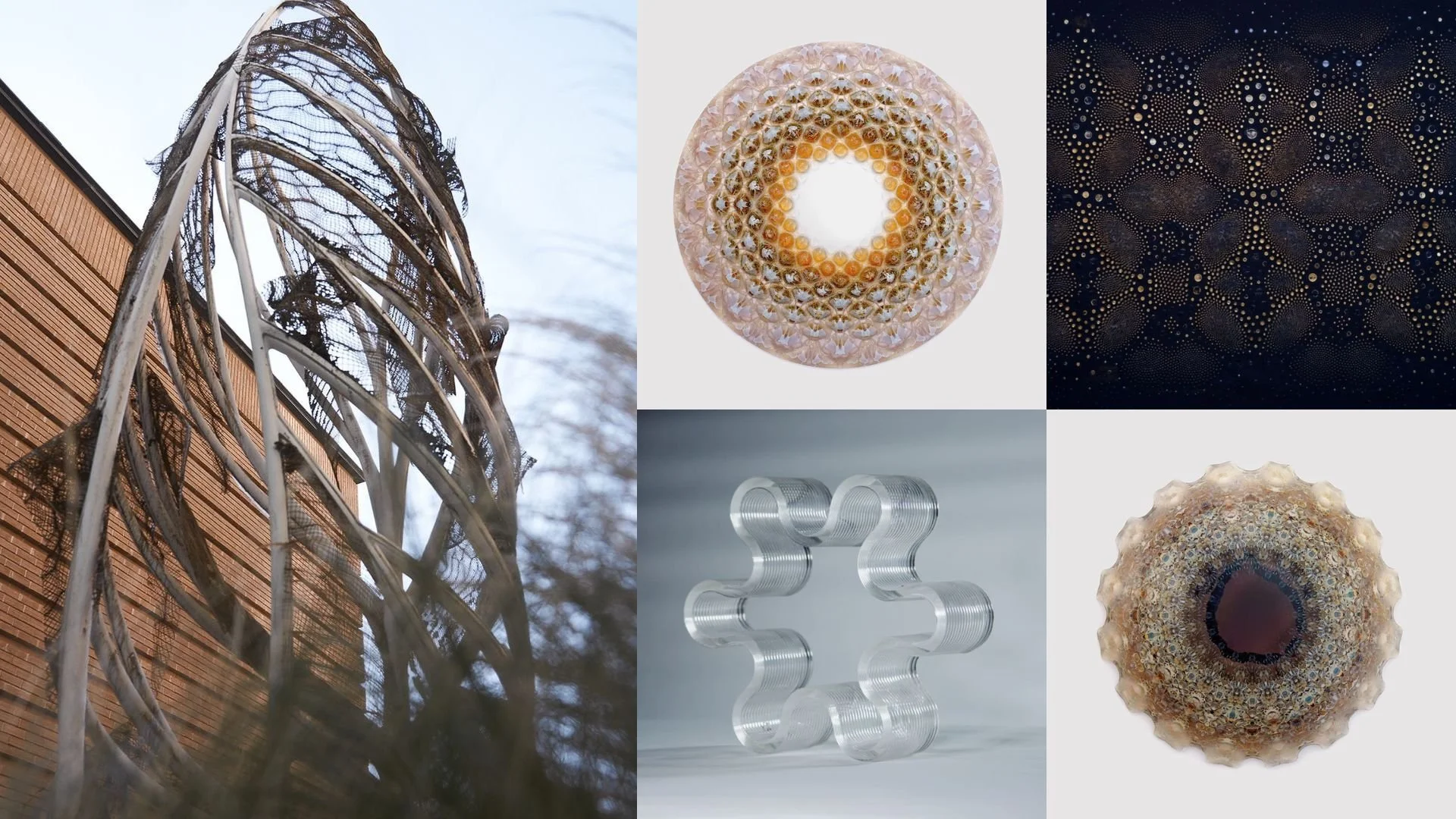
For the Silk Pavilion, Oxman and her collaborators combined digital fabrication with the work of thousands of silkworms, allowing biological behaviour and human-made technology to become part of the same construction process.
Other projects have experimented with materials derived from substances found in nature, including cellulose and chitin, exploring whether objects and structures might one day be created with fewer synthetic materials and less waste.
Her work has also used 3D printing to explore glass, wearable structures and forms inspired by the way living tissues behave. Many of these projects are experimental rather than products intended for everyday use. The point is not always to create something ready for the market.
Sometimes the point is to discover what might be possible.
Oxman's work has been exhibited and collected by institutions including the Museum of Modern Art in New York, which devoted an exhibition to her idea of Material Ecology.
But what interests me most isn't any one object she has made.
It's the change in perspective behind them.
For a long time, humans have looked at nature and asked what we can take from it.
Oxman's work suggests another question:
What could we learn from the way nature makes things in the first place?
Perhaps innovation doesn't always begin by inventing something nature has never seen.
Sometimes it begins by noticing what nature has been doing all along.




Watch: Three Women, Three Ways of Looking at the Future
Science rarely moves in only one direction.
In this Scripps News conversation, Seema Kumar, Tracy Fanara and Meredith Broussard bring three very different perspectives to questions shaping our lives—from healthcare and vaccine safety to climate change and artificial intelligence.
They also talk about their own paths into STEM, the challenges they have encountered and what happens when women are part of the conversations shaping science and technology.
Three different fields. Three different careers.
And three reminders that there is no single way to belong in STEM.

ANNE-MARIE IMAFIDON
Who Gets to Imagine Herself Here?
Where Curiosity Can Go Next
Curiosity matters. But so does having somewhere to take it.
A girl may love solving problems, taking things apart, writing code or wondering how the world works and still have no idea what she could do with that interest—or who might help her explore it.
The organizations below offer different kinds of support, from hands-on STEM programs and mentoring to scholarships, workshops and resources for educators.
Some are local. Some reach across borders. All are places to start.
Programs change, eligibility changes and opportunities come and go, so please check each organization's website for current details.
Global
AFS Global STEM
International STEM programs combining science, sustainability, intercultural learning and problem-solving. Some opportunities are specifically designed for young women and are offered through scholarships.
Rwanda
Starlight Africa
Helps girls in Rwanda explore STEM through clubs, camps, hands-on projects, competitions and mentorship, while also training teachers to create stronger STEM learning environments.
Across Africa
WAAW Foundation
Supports African women and girls in STEM through scholarships, mentorship, university chapters, outreach and hands-on education. Its network reaches communities across the African continent.
United Kingdom
Stemettes
Offers girls, young women and non-binary young people opportunities to explore STEAM through mentoring, events, workshops, clubs and connections with people already working in the field. Programs span ages 5–25.
Argentina
Chicas en Tecnología
An Argentine organization working to reduce the gender gap in technology by helping girls and young women develop digital skills, explore technology and connect with opportunities in the field.
Australia and Beyond
Robogals
A student-led global organization introducing young women to engineering and related fields through workshops and hands-on learning. Schools, parents and students can use its chapter network to find opportunities nearby.
United States & Online
National Girls Collaborative Project (NGCP)
A large network connecting organizations, educators and resources working to expand girls' participation in STEM. Especially useful for parents, educators and anyone looking for research, programs, role models and practical STEM resources.
Explore the National Girls Collaborative Project
Girls Who Code
Offers free opportunities to learn computer science and explore technology, from clubs for younger students to online programs in coding, AI, cybersecurity, data science and web development, as well as career support for young adults.
Techbridge Girls
Creates hands-on STEM opportunities for girls and gender-expansive youth, with a particular focus on Black, Latina and Indigenous communities. Its programs connect subjects such as engineering, AI and data science with problems young people care about in their own communities.


Anne-Marie Imafidon was eleven when she passed an A-level in Computing.
At twenty, she completed a master's degree in Mathematics and Computer Science at Oxford.
The numbers tell us that she was exceptional.
Another number tells us something else.
At university, Imafidon was one of only three girls in a class of seventy studying Mathematics and Computer Science.
She had found her way into technology.
But where were all the other girls?
That question stayed with her.
After university, Imafidon worked in technology and finance, including roles at Hewlett-Packard, Goldman Sachs and Deutsche Bank. Then, in 2013, she created Stemettes, an organisation designed to give girls and young women something she had seen too little of herself: the chance to explore science and technology in spaces where they did not feel like the exception.
Since then, Stemettes has introduced tens of thousands of young people to STEM through events, mentoring, workshops and other programs.
But perhaps the most interesting part of Imafidon's work is the idea underneath it.
Ability isn't the only thing that determines where we end up.
We also need to know that a place exists for us.
We need to see people who make that possibility believable. We need opportunities to try things before deciding whether we belong. And sometimes we simply need someone to invite us into a room we hadn't imagined entering.
In her book She's in CTRL, Imafidon takes that idea beyond careers in technology. She asks women to think about their relationship with the technology already shaping their lives—and why they should have a voice in creating what comes next.
Because technology doesn't simply happen to us.
People build it.
People decide what problems it solves, whose needs it considers and what kind of future it helps create.
Perhaps the question isn't only whether girls are capable of succeeding in STEM.
We know they are.
The more interesting question is whether they are being given enough chances to discover that for themselves.
Watch: Anne-Marie Imafidon on Changing Who Gets to Shape Technology
Hear Anne-Marie talk about her journey into technology, the thinking behind Stemettes and why representation in STEM matters.
HAYAT SINDI
What Good Is an Invention If Nobody Can Use It?
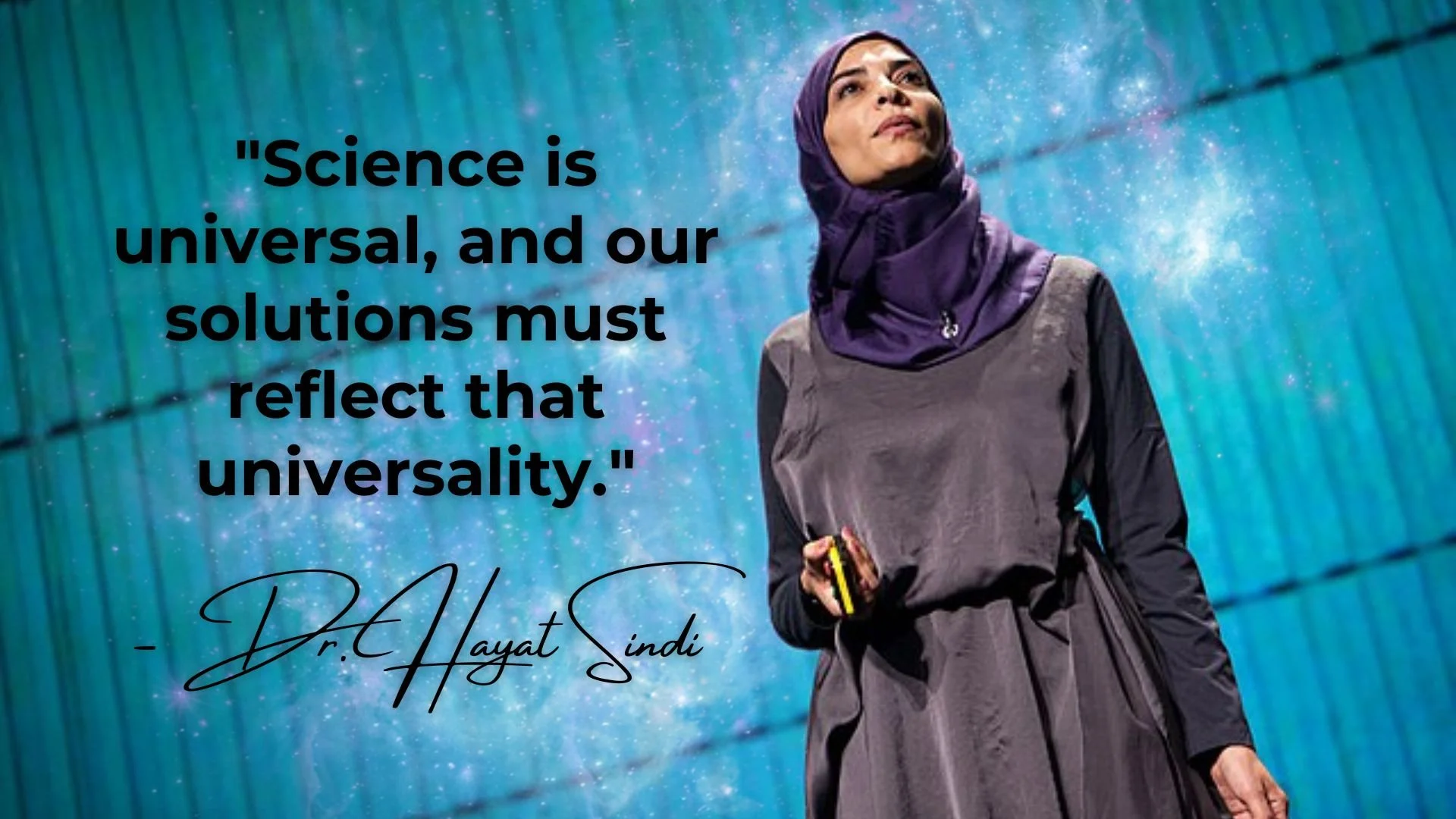
Hayat Sindi left Saudi Arabia for Britain when she was a young woman with an ambition to become a scientist.
There was one immediate problem.
She didn't yet speak English.
So she learned.
Sindi went on to study pharmacology at King's College London and later completed a doctorate in biotechnology at Cambridge. Her scientific career could easily have followed the familiar path of laboratories, research papers and increasingly sophisticated technology.
But another question began to interest her.
Who would actually be able to use what scientists were inventing?
For a diagnostic test to help someone, it isn't enough for the science behind it to be brilliant. The test has to reach the patient. It has to be affordable. It may need to work somewhere without a sophisticated laboratory, reliable electricity or highly trained medical staff.
That changes the problem.
Sindi became involved in developing simple, low-cost diagnostic technologies designed with those limitations in mind. She later co-founded Diagnostics For All, a nonprofit created to develop inexpensive point-of-care tests for places where conventional medical testing can be difficult to access.
The idea behind the work was not to make science less advanced.
It was to ask more of it.
Can an innovation still be called successful if the people who need it most cannot afford it?
Can technology solve a problem if it only works in places that already have the resources to support it?
Those questions eventually took Sindi beyond her own research. She founded the i2 Institute for Imagination and Ingenuity to help young scientists and engineers in the Middle East turn ideas into practical solutions. She has also worked internationally to promote science education and greater opportunities for young people, particularly girls and women.
Her own journey opened doors that had rarely been open to Saudi women before her.
But perhaps the more interesting part of her story is what she chose to do once she walked through them.
Sindi's work asks us to think about innovation differently.
The most impressive technology is not necessarily the most complicated.
Sometimes it is the one simple enough, affordable enough and practical enough to reach the person who was being left out.
Because an invention doesn't change a life simply by existing.
It has to reach one.
Watch: Hayat Sindi on Science That Reaches People
Hayat Sindi talks about science, innovation and the importance of developing solutions that can make a practical difference in people's lives.
ADRIANA OCAMPO
The Girl on the Roof

Adriana Ocampo used to climb onto the roof of her family's home in Argentina and look at the night sky.
She wondered what the stars were made of and whether there might be life somewhere beyond them.
Then she came back downstairs and built spacecraft from her mother's pots and pans.
Her doll was the astronaut.
Her dog, Taurus, was the co-pilot.
Years later, Ocampo would spend her career helping real spacecraft explore some of the places she had once imagined.
Born in Colombia and raised in Argentina, she moved with her family to the United States as a teenager. Soon after arriving, she wanted to know one thing:
Where was NASA?
While still in high school, she found her way to the Jet Propulsion Laboratory through a space-exploration program. She began as a volunteer, later worked there during the summers and continued at JPL while studying geology.
Eventually, the girl who had looked up at other worlds became a planetary geologist trying to understand them.
Her career at NASA has included leadership roles connected with missions to Jupiter, Pluto and beyond, and the asteroid Bennu. But one of her most important contributions began not by looking outward into space, but downward at Earth.
While studying satellite images of Mexico's Yucatán Peninsula, Ocampo and her colleagues noticed something unusual: a vast semicircular pattern of sinkholes called cenotes.
The pattern was connected to something buried beneath the surface.
The Chicxulub impact crater.
Other scientists had already detected evidence of the enormous buried structure. Ocampo and her colleagues helped reveal its surface expression and strengthen the evidence connecting it to the asteroid impact that occurred about 66 million years ago, when three-quarters of Earth's plant and animal species disappeared, including the non-avian dinosaurs.
Suddenly, studying one scar on Earth could tell us something about events far beyond it.
That is one of the things I find most beautiful about Ocampo's work.
The questions she asked as a child never really disappeared.
What is out there?
What happened here?
How are the two connected?
Science gave her better instruments than pots and pans.
But perhaps it never required her to stop being the girl on the roof.
Sometimes curiosity grows up with us.
If we're lucky, we don't grow out of it.