

Women in Healthcare
What does it mean to care for someone's health?
It can mean diagnosing an illness, developing a treatment or saving a life. But healthcare is also shaped by things that happen long before anyone enters a doctor's office: where we are born, what we can afford, whether care is available to us, and whether anyone is paying attention to the people most easily overlooked.
The women featured here have worked in different corners of healthcare. What connects them is a willingness to look beyond the obvious problem and ask a harder question:
Who is still being left out?
Agnes Binagwaho
Who Gets to Be Healthy?
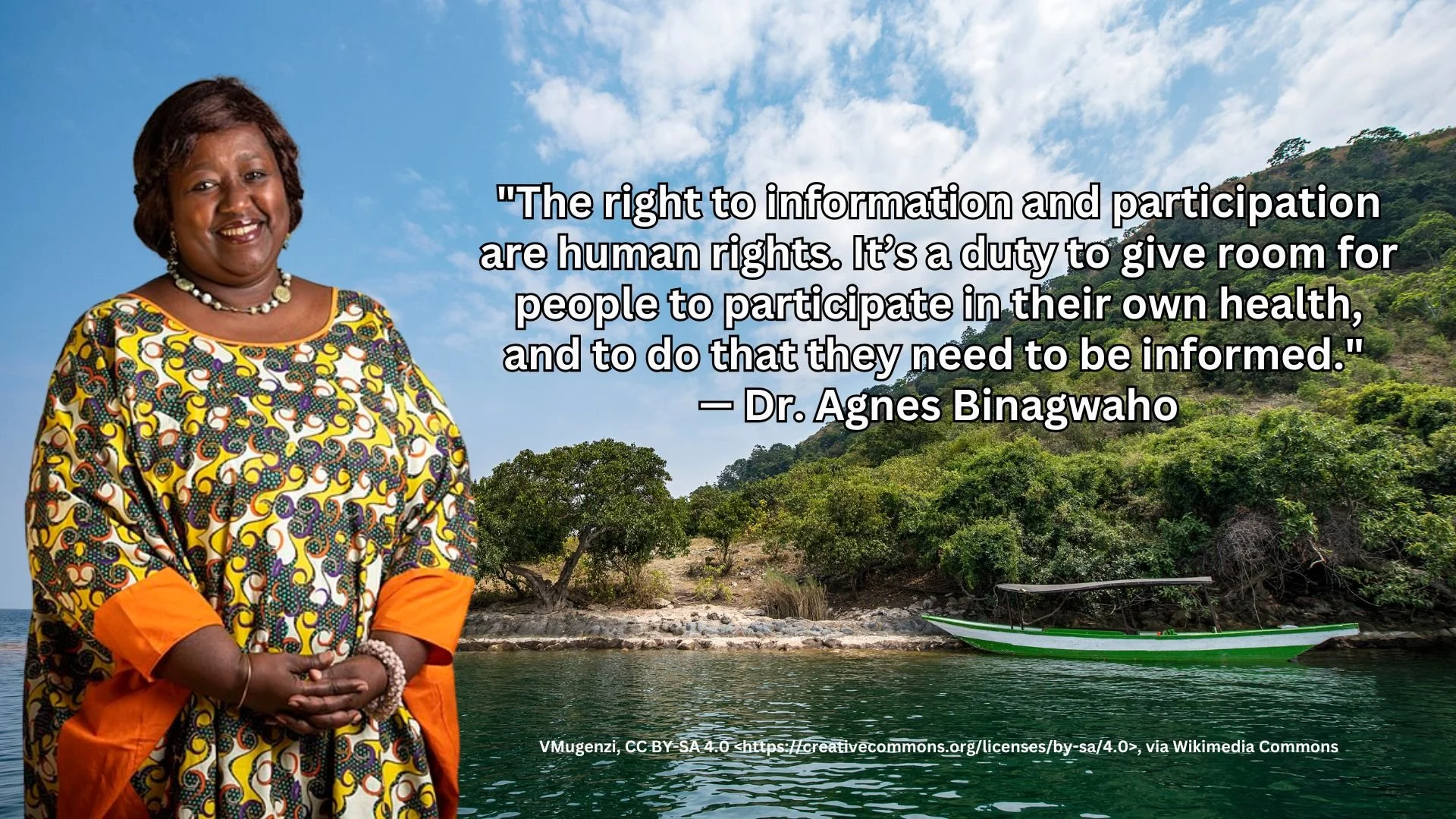
Agnes Binagwaho returned to Rwanda in the years after the 1994 genocide and found a country rebuilding almost everything—including its healthcare system.
A pediatrician by training, she went on to spend years in public health leadership, eventually becoming Rwanda's Minister of Health. During that period, the country made remarkable progress in areas including maternal and child health, HIV treatment and access to care.
But the idea at the heart of Binagwaho's work is surprisingly simple: good healthcare means very little if the people who need it cannot reach it.
A prescription is not enough if a patient lives kilometres from a clinic and has no affordable way to get there. A treatment may exist, but that doesn't make it accessible. And telling people to take better care of themselves ignores the circumstances that can make doing so almost impossible.
This way of thinking also shaped Binagwaho's work in medical education. At the University of Global Health Equity in Rwanda, where she served as Vice Chancellor, students have been taught to look beyond symptoms and consider the larger forces affecting a person's health—poverty, geography, education, inequality and access to care.
It changes the question.
Instead of asking only, “How do we treat this patient?”, healthcare professionals are also asked to consider, “What is preventing this patient from getting well?”
That distinction may sound small.
It isn't.
Binagwaho's work reminds us that healthcare doesn't become equitable simply because good medicine exists. It becomes equitable when good medicine can actually reach the people who need it.
And perhaps that is the harder measure of a healthcare system: not how well it serves those who can easily enter it, but how far it is willing to go for those who cannot.

Video Spotlight: Agnes Binagwaho on Teaching Global Health Equity
What if medical education taught future doctors to look not only at illness, but at everything surrounding it?
In this conversation, Agnes Binagwaho explains an approach to healthcare that considers where people live, what resources they have and the barriers that can stand between a patient and the care they need.

Rupa Marya
Looking for the Cause Beneath the Cause

When Rupa Marya looks at illness, she doesn't begin and end with the body.
She asks what surrounds it.
A physician, Marya has spent much of her career examining the connections between health and the conditions in which people live: poverty, racism, environmental damage, displacement, access to food and the long effects of colonialism.
Her central argument is that treating disease without looking at those conditions can mean treating only part of the problem.
That idea has taken her well beyond the walls of a hospital.
Marya co-founded the Do No Harm Coalition, bringing healthcare workers together around the social and structural conditions that affect health. She later founded the Deep Medicine Circle, whose work connects health with food systems, land, community and Indigenous knowledge. She has also worked alongside Indigenous health leaders on projects connecting medicine, food, land and community, including the Mni Wiconi Health Clinic and Farm.
In Inflamed: Deep Medicine and the Anatomy of Injustice, written with Raj Patel, Marya takes the argument further. The book explores inflammation not only as a biological process, but as a way of thinking about the relationship between our bodies and the environments and systems around us.
Not everyone will agree with every conclusion she draws. But the question at the centre of her work is worth considering:
What if we keep treating the illness without changing some of the conditions that help produce it?
Marya's life makes that question particularly interesting because medicine is only one of the ways she explores it.
She is also a musician and composer, the frontwoman of Rupa and the April Fishes. Her music moves between languages, cultures and genres, much as her work in medicine moves between disciplines that are often kept apart.
Perhaps that is what makes her approach so distinctive.
She keeps looking for connections where we have become accustomed to seeing separate things: body and environment, medicine and justice, illness and society, science and art.
Sometimes healing begins with treatment.
Sometimes it begins by asking why the wound keeps appearing.
Joanne Liu
Refusing to Get Used to It
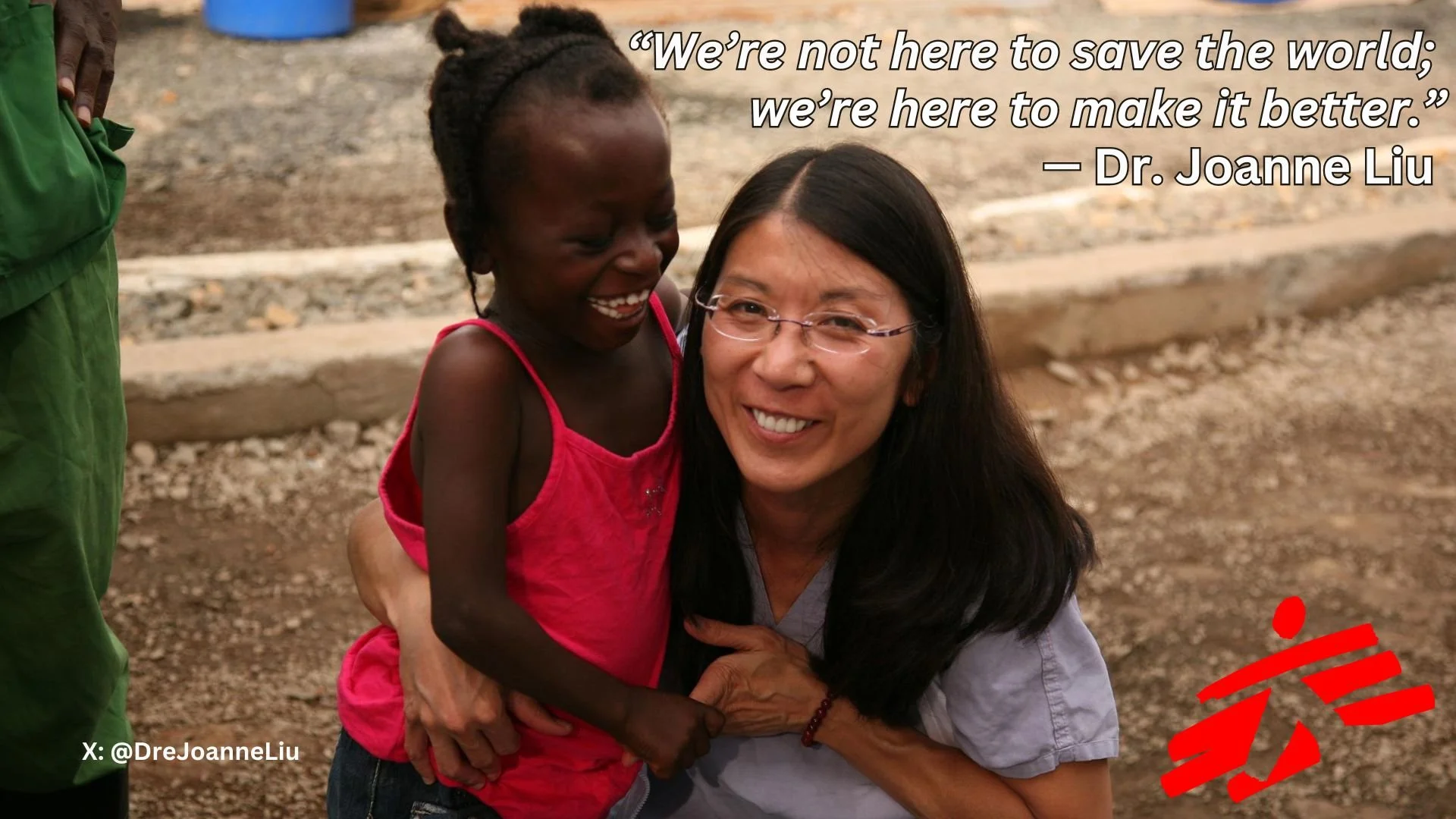
Joanne Liu was thirteen when she began imagining a life in humanitarian medicine.
She had been reading about doctors working in places affected by war and crisis. Around the same time, she discovered Albert Camus's The Plague and its doctor, Bernard Rieux, a man who continues caring for the sick even when there seems to be very little he can do.
Something in that stayed with her.
Liu went on to become a pediatric emergency physician and joined Médecins Sans Frontières—Doctors Without Borders—in 1996. Over the years, her work took her into conflicts, epidemics and humanitarian emergencies around the world.
Eventually, she became the organization's International President.
Her six years in that role included some of the most difficult moments in recent humanitarian medicine. During the Ebola epidemic in West Africa, Liu publicly challenged the international community for responding too slowly while health workers struggled to contain the outbreak. After an MSF hospital in Kunduz, Afghanistan, was destroyed in a US airstrike, she spoke before the United Nations Security Council about the need to protect hospitals, patients and medical workers during war.
Again and again, her work brought her back to a basic principle: even in a crisis, some things should never become normal.
That idea may have begun much earlier.
Liu grew up in Quebec City, the daughter of Chinese immigrants who ran a busy restaurant. She has recalled watching her family quietly feed people who could not afford to pay. No announcement was made. Nobody was made to feel like a charity case. The person ate, brought the bill to the counter, and was allowed to leave with dignity intact.
Years later, after witnessing extraordinary suffering around the world, Liu would return to that same word: dignity.
Medicine can stop bleeding, fight infection and sometimes save a life. But how people are treated while they are frightened, displaced, sick or powerless matters too.
Today, Liu's work also looks toward the crises we haven't faced yet. Through her work in pandemic and emergency preparedness, she asks how health systems can become better prepared before the next emergency arrives.
Perhaps that, too, comes from refusing to get used to things we should never accept.
A crisis may change what is possible.
It doesn't have to change how much a human life matters.
Canan Dağdeviren
The Drawing Beside the Bed
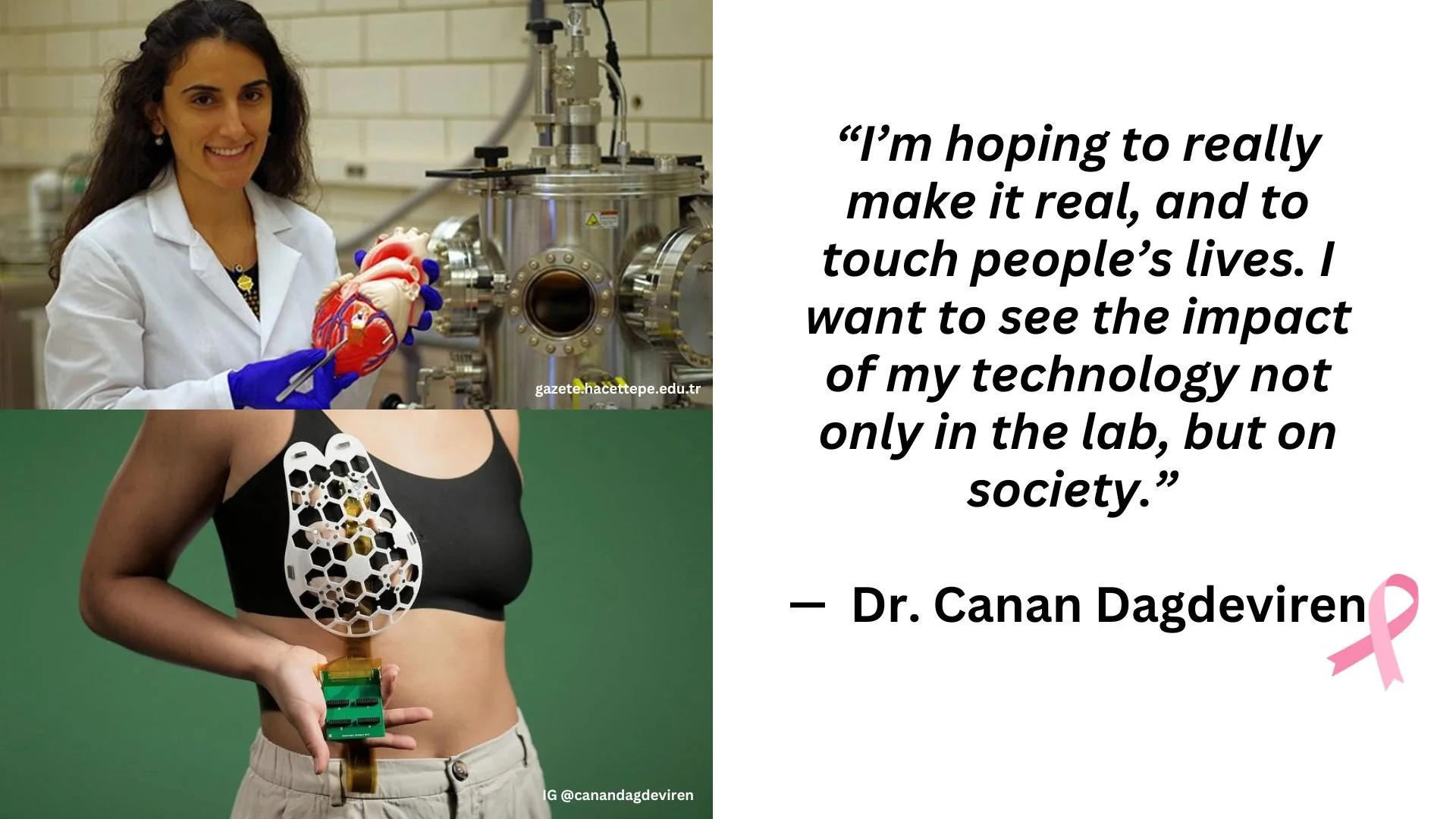
In 2015, Canan Dağdeviren was sitting beside her aunt Fatma, who was dying of breast cancer.
Her aunt had been diagnosed at forty-nine, despite having regular screenings. Six months later, she was gone.
But before she died, Dağdeviren took out a piece of paper.
She began to draw.
What she sketched beside her aunt's bed was an idea for a device that could be worn on the body and used to image breast tissue more frequently, particularly for women at higher risk of developing breast cancer.
At the time, it was only a drawing.
Dağdeviren was already a scientist and engineer, working at the intersection of materials science, electronics and the human body. Born in Turkey, she had studied physics before earning a doctorate in materials science and engineering. Her research focused on an unusual challenge: how do we make technology adapt to the human body instead of asking the human body to adapt to technology?
Years after that first sketch, her team at MIT developed a flexible ultrasound patch that can be attached to a bra and used to scan breast tissue from different angles. The technology is designed to make more frequent imaging possible, especially between routine screenings for people at higher risk.
The work is still evolving. Dağdeviren and her team continue to develop smaller, more portable ultrasound systems that could eventually make breast imaging easier to access and use.
What began beside one hospital bed has grown into something much larger.
Today, Dağdeviren leads research at MIT developing technologies that bend, stretch and conform to the body. Her work extends beyond breast health, but the question underneath it remains remarkably human:
Can we build technology around the person who needs it?
There is something about that first drawing that stays with me.
Faced with the loss of someone she loved, Dağdeviren could not change what was happening in that room.
So she began thinking about what might be changed outside it.
Sometimes an idea begins with an answer.
Sometimes it begins with wishing there had been a better one.
Read the Falling Walls profile of Canan Dağdeviren